+62 817-4929-054


Arm Feels Heavy, Making Even Simple Tasks Like Combing Hair Difficult—A Common Occurrence in Patients with a Rotator Cuff Tear
17 November 2026
3 min read


By: dr. Jefri Sukmawan, Sp.OT Subsp.OBS (K)
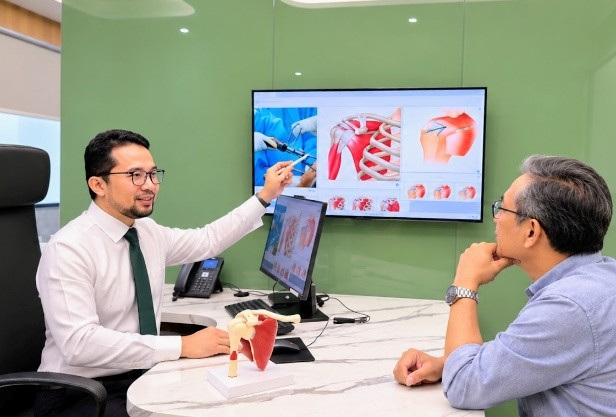
Have you ever experienced pain on the outer or front part of your shoulder that worsens at night? Or perhaps your arm feels so weak that even simple tasks—like combing your hair or lifting an object—become difficult? If so, you might be suffering from a condition known as a rotator cuff tear.
What Is the Rotator Cuff?
The rotator cuff is a group of four muscles and tendons that surround your shoulder joint. It plays a crucial role in both moving your arm and maintaining its stability. A tear occurs when one of these tendons detaches or rips away from the bone.
What Are the Symptoms?
Someone who has a rotator cuff tear will typically experience several characteristic symptoms, such as the following:
- Shoulder pain: Felt on the outer or front part of the shoulder and typically worsens at night.
- Weak arm: Difficulty or a feeling of weakness when lifting the arm, for example, while combing one's hair.
- Clicking sound: A 'clicking' sound occurs when the shoulder is moved.
Why Does It Tear?
In general, there are two main causes for this condition:
- Age Factor (Aging): As one ages (particularly after the age of 40), the natural strength of the tendons declines.
- Acute Injury or Repetitive Motion: This can occur as a result of a fall onto an outstretched hand, lifting heavy objects suddenly, or frequently performing repetitive arm movements above the head.
Bagaimana Dokter Memeriksanya?
To confirm a diagnosis, an orthopedic specialist will typically conduct a two-stage examination:
- Physical Examination: The doctor will assess the strength of your shoulder and identify areas of pain through specific movements (such as the "empty can" test, "drop arm" sign, and palpation of the tendons).
- Radiological Examination (Imaging):
- X-ray: Used to rule out other conditions, such as arthritis.
- Ultrasound: A quick and affordable method used for initial screening.
- MRI: The most frequently chosen diagnostic tool, as it provides the most detailed imagery for planning medical interventions or surgery.
Treatment Options
Managing this condition does not always require surgery. Your doctor will take into account your age, daily activities, the size of the tear, and how your body responds to therapy. Treatment options include:
- Non-Operative Method (Without Surgery): Suitable for small tears or elderly patients. Treatment includes physical therapy, strengthening exercises, and the administration of pain relievers or anti-inflammatory medication.
- Operative Method (Surgery): Recommended if the tear is full-thickness or if non-operative treatment does not yield results. A common procedure is arthroscopy—a minimally invasive surgery that uses a small camera and requires only very small incisions, allowing for a faster recovery. Following surgery, patients typically wear an arm sling for 4–6 weeks.
Recovery Timeline
The healing process following treatment typically unfolds in stages, leading up to your return to normal activities:
- Weeks 0–6: Use a protective sling and focus on pain management.
- Weeks 6–12: Gradually begin passive and active range-of-motion exercises.
- Months 3–4: Focus on strengthening exercises for the shoulder muscles.
- Months 4–6: Begin returning to full, normal activities.
When Should You Get Checked?
Do not delay in consulting a specialist if you experience:
- Shoulder pain that lasts for more than 2–4 weeks.
- The arm feels weak or is difficult to lift.
- Pain at night that interferes with the quality of your sleep.
With appropriate and early intervention, most patients can return to using their shoulders normally for daily activities.
Contact us
For information and make an appointment

dr. Jefri Sukmawan, Sp.OT, Subsp. OBS
Orthopedi & Traumatologi View Schedule| Loading data... |
|---|